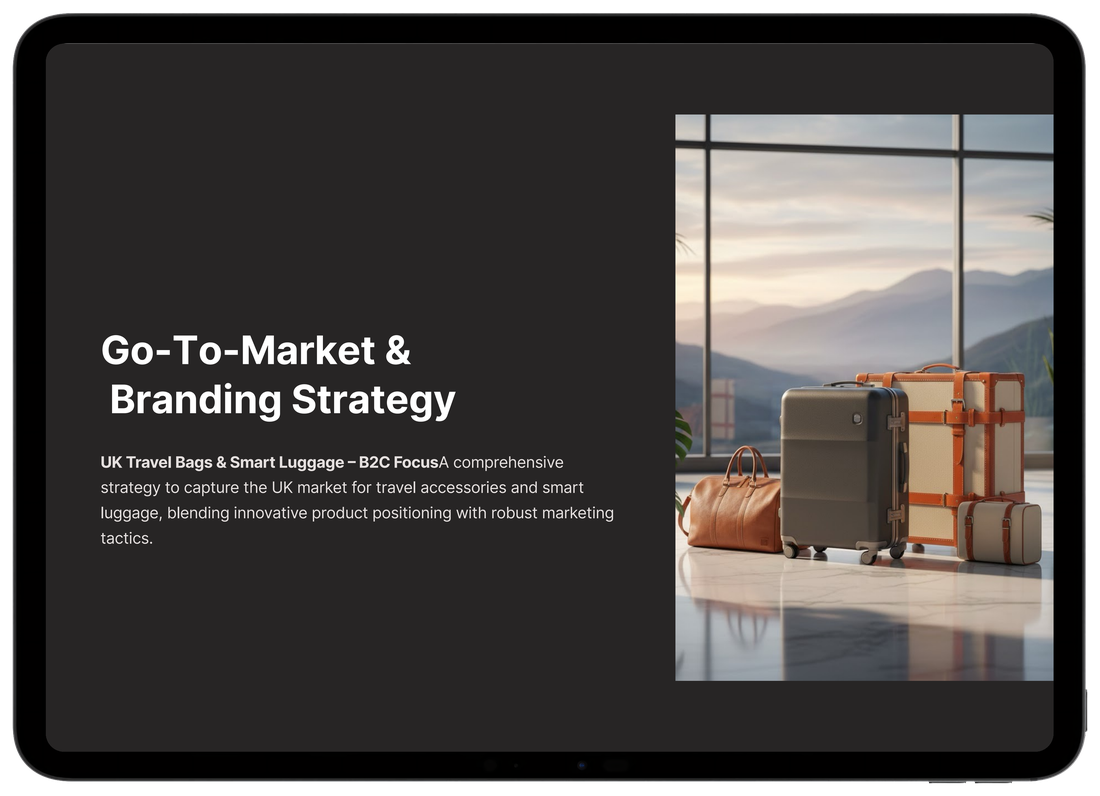
The full deck
The go-to-market & branding strategy
Every slide behind this case study — the research, the charts and the plan exactly as it was presented.
PDF · 11 pages
A complete go-to-market and branding strategy for a direct-to-consumer travel bag and smart luggage brand entering the UK — from market sizing and competitive gap analysis through positioning, channels and a 90-day launch plan.
Smart luggage — GPS tracking, USB charging — is the category’s growth engine, and e-commerce is outpacing traditional retail.
Competitors compete on brand or design. Nobody competes on price clarity plus smart value bundles. That was the opening.
The core promise: smart, practical travel solutions at simple and accessible prices. Four pillars carry it.
| Segment | Players | How they compete |
|---|---|---|
| Luxury | Rimowa, Horizn Studios | Premium materials, strong branding, emotional and design-led marketing |
| Mid-premium | Antler, Delsey, Samsonite | Heritage, durability, global presence |
| Affordable | CabinMax, IT Luggage, Tripp, Eastpak | Price and basic functionality |
Few brands offer smart bundles, a genuine DTC value strategy, aggressive UGC, or any specialism in the under-seat niche. The strategy targets exactly that space: affordable smart travel solutions for the UK market.
Primary: budget-conscious travellers, frequent short-trip travellers, young professionals and students, and families flying low-cost airlines. Secondary: digital nomads, city-break enthusiasts and practical business travellers.
Content runs on four pillars: educational guides, value comparison, travel hacks and social proof. A creator PR-kit programme builds trust faster than paid advertising can.
The long-term position is a recognised UK-focused smart and affordable travel brand, built on five moves: smart pricing, smart travel, UGC acceleration, bundle innovation and SEO authority.
Not competing on luxury or heritage. Competing on smart value, smart travel, smart pricing — a scalable and defensible position.
The full deck
Every slide behind this case study — the research, the charts and the plan exactly as it was presented.
PDF · 11 pages